
SAT, ACT & Testing Decisions

Testing is easier to plan when you know what each test is for. Early assessments help you see which skills to strengthen. The SAT and ACT may be used for college admission. Advanced Placement (AP) exams assess learning in individual subjects and may earn credit toward a college degree or allow you to start at a higher course level.

Begin with the assessments your school offers and the decisions that apply to your grade.

A student writes at a classroom desk.

Understand early assessments and National Merit

In Grades 8–10, an early assessment can introduce the test format and show where you need more practice. It is a starting point for learning, not a college admission result.

Assessment Usual stage What it helps you do
PSAT 8/9 Grades 8–9 Check reading, writing and math skills before later SAT Suite tests
PSAT 10 Grade 10, generally in spring Review these skills and prepare for later testing
PSAT/NMSQT Often Grades 10–11, in fall Prepare for the SAT and, in the qualifying year, enter the National Merit scholarship competition
PreACT 8/9 Grades 8–9 Try ACT-style questions and identify skills to develop
PreACT Usually Grade 10 Review subject skills and receive predicted future ACT score ranges

Schools choose which assessments they offer. Check your school’s website or testing emails for the test’s full name, date and sign-up instructions. If you cannot find them, ask the school testing coordinator.

Some schools use PreACT 9 Secure in Grade 9 or PreACT Secure in Grade 10. These are school-arranged versions of early ACT preparation tests. ACT’s PreACT overview explains the options. The PreACT Composite, or overall score, combines English, math and reading; the school or district chooses whether to include science.

What National Merit offers

A student works independently at a home desk.

The National Merit Scholarship Program recognizes high-achieving students and awards money for college. Awards include national $2,500 scholarships and scholarships sponsored by businesses and colleges. The PSAT/NMSQT gives eligible students a chance to compete for this recognition and funding.

Only the PSAT/NMSQT is the qualifying test; PSAT 8/9, PSAT 10 and PreACT do not qualify you. For students spending four years in high school, the qualifying test is normally in fall of Grade 11. Taking it in Grade 10 does not replace the junior-year test.

High PSAT/NMSQT scores can lead to recognition and, for some students, further scholarship consideration. Students who advance must meet additional requirements, including an application and a strong academic record. A high score alone does not guarantee a scholarship.

Check your school’s arrangements before junior-year fall. If your school does not offer the test, including if you are homeschooled, contact a nearby testing school early about a place. The current National Merit student guide explains eligibility, different graduation schedules and what to do if illness or an emergency prevents testing.

Decide whether to take the SAT or ACT

A hand writes on a worksheet beside a laptop and notebook.

Grade 11 is a useful time to plan a first SAT or ACT attempt because it leaves time to review your results and prepare for another attempt before college applications are due.

Once you begin researching colleges, look at their admissions websites for testing policies for your application year.

  • Test-required means the college requires the specified scores, subject to any stated exceptions.
  • Test-optional means you can apply without SAT or ACT scores under that policy. Taking a test is still a good idea when you can prepare for it and the result could be useful. A strong score can support an application at a college that considers scores, help with scholarships that use them and keep options open as your college list develops.
  • Test-free or test-blind means SAT or ACT scores are not considered for admission under that policy.
  • Test-flexible means specified alternatives may be accepted. The college’s policy explains which ones.

Choose between the SAT and ACT

The SAT tests Reading and Writing and Math. The ACT’s English, math and reading scores make up its Composite score. ACT science and writing are optional additions for national testing and do not affect that Composite.

The differences below can help you decide which test suits you.

  • Reading and writing. The SAT uses short passages with one question each. ACT reading uses passages or passage pairs with several questions. Try sample questions to see whether you prefer moving between short texts or spending longer with one passage.
  • Math. Both tests cover algebra, geometry, trigonometry and data analysis. The SAT gives much of its math section to algebra and advanced algebra. The ACT also includes topics such as matrices and logarithms. Compare the official SAT math topics and ACT math topics with the math you have learned.
  • Science. The ACT’s optional science section gives you a separate score for interpreting scientific information, including graphs and experiments. It may be worth taking if these are strengths you want to show. The SAT includes science-related reading and math questions but has no separate science section.
  • Format and pacing. The SAT is digital; your answers in the first part of each section affect the difficulty of the second. The ACT offers paper and online testing, depending on availability. Under standard time limits, the SAT allows more time per question. A timed practice test can show whether the pacing works for you.

The official SAT structure and ACT section guide provide timing and sample content. If the choice remains unclear, try a timed practice test for each. Compare your results using the official SAT–ACT score comparison, since the tests use different score scales. Then focus your preparation on the test that fits your strengths and is practical for you to take.

Prepare with a manageable plan

Begin with official practice that matches your test. For a younger student, a preview and sample questions may be enough to start. Closer to an SAT or ACT date, a full practice test helps you see both skill gaps and timing problems.

Free resources include the following.

  • College Board practice includes Bluebook practice tests and previews, the Student Question Bank and Official SAT Prep on Khan Academy. Choose the SAT or PSAT material appropriate to your assessment.
  • ACT’s free preparation resources include sample questions and practice tests.
A student studies with a notebook and laptop in the library.

Review mistakes before doing more questions. Did you miss a concept, misread the question or run out of time? Choose one or two areas to work on. For example, if you can solve equations but struggle to turn word problems into equations, practice that step instead of repeating an entire math test.

A starting routine might be two 30-minute skill sessions each week, with occasional timed practice. Learn from answer explanations, then try fresh questions to see whether you can use the skill independently. Add longer practice as the test approaches. Paid preparation is optional.

Practice with the format and permitted tools you will use on test day, including a digital calculator or approved accommodations. If a question remains confusing after you review its explanation, bring that question to a teacher or tutor.

Register and arrange testing support

A school-day SAT or ACT may offer a convenient way to test. Follow your school’s sign-up instructions, including which ACT sections it will administer. The tests can also be taken outside of school, typically on a Saturday. To look for available dates and sign-up, use SAT registration or ACT registration.

Before registering, check the date, deadline, location and fee. Allow time for results before application or scholarship deadlines. If you might retest, leave room for preparation between attempts. Fee waivers or school funding may help eligible students with costs.

Follow the testing provider’s instructions for identification, permitted equipment and device setup before test day.

If you need disability accommodations, contact your school’s testing coordinator, the staff member who organizes school testing. Begin well before the test date because approval can take several weeks. Classroom accommodations do not automatically establish testing approval. The school testing coordinator can help with College Board requests or ACT requests, and explain which English learner supports are available for your test.

Use your scores and consider retesting

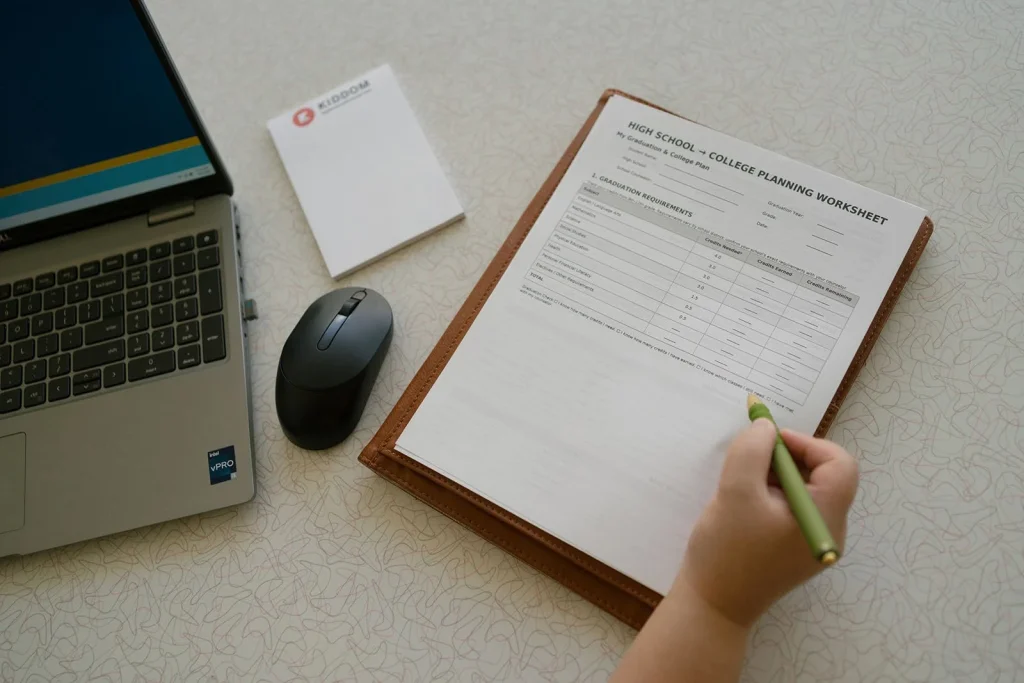
A student writes on a planning worksheet beside a laptop.

Read the subject and skill information alongside the total. Early score reports from practice tests can identify material you have not learned yet as well as areas that need practice.

After an SAT or ACT attempt, another test may be useful if you can identify what to improve and have time to work on it. Retesting without changing your preparation is less useful. Consider the cost and time alongside any score requirement you are trying to meet.

When submitting scores is optional, compare your result with the college’s guidance and published score range. A range is context, not a rule that guarantees admission or rejection.

Some colleges superscore, combining your highest applicable section scores from different test dates. Others use scores differently. Some allow you to self-report scores in the application; others require an official report from the testing organization. Check the college’s score-reporting instructions when you are ready to apply, so you send what it actually needs. ACT’s score guide explains its current Composite and superscore.

Plan your AP exams

A student and teacher work through an open book together.

AP exams have a separate registration process, usually beginning in fall for testing in spring. Some schools require students in an AP course to take its exam.

Follow registration and payment instructions from your AP teacher or the staff member who organizes AP exams at your school. Look for your school’s exam registration deadline early in the fall. College Board’s AP fee page explains costs, fee reductions and late or canceled exam charges.

If you study independently or your school does not administer the exam, use College Board’s host-school guidance early in the school year. A host school must agree to test you. Most AP exams allow self-study, but some subjects require course-based work or other assessments. Check the course and exam directory before committing to an extra exam.

For preparation, use your course work, official sample questions and AP practice resources. Some AP scores also depend on work submitted before the exam. For example, AP Computer Science Principles includes a programming project with its own submission deadline. Include any required project deadlines alongside exam dates in your study plan.

A qualifying AP exam score may earn college credit that counts toward a degree. It may also let you skip an introductory college course and begin with a more advanced one; this is called advanced placement. A college may offer credit, placement, both or neither for a particular score. Once you have likely colleges in mind, their published AP policies can show how your scores might be used. College Board’s credit and placement guide explains the distinction.